Recent development in demand analysis, Microeconomics

Assignment Help:

RECENT DEVELOPMENT IN DEMAND ANALYSIS:

For many years economic theorists analysed the optimal behaviour of consumers while econometricians estimated consumer demand and expenditure relations, with little communication between the two. Theorists would provide examples that were of little aid for empirical work, and econometricians would estimates relations that had little connection with the theory of utility maximisation. Fortunately, as days passed on, the gap between theory and empirical evidence has lessened, and a number of theoretically strong examples that allow empirical estimation have been developed. In this section we present one of such examples.  

127_RECENT DEVELOPMENT IN DEMAND ANALYSIS.png

with the domain q11 and q22. The  γ's may be interpreted as minimum subsistence quantities and are positive. The α's are also positive. Applying the positive monotonic transformation U' = U/(α +α ) we get,  

2426_RECENT DEVELOPMENT IN DEMAND ANALYSIS1.png

The coefficients β1 and β21+ β2 = 1) are called "share" parameters. The consumer's objective is to maximise her utility subject to budget constraint. So, she will try to solve the problem given below. 
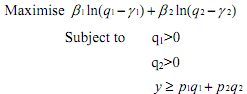
2482_RECENT DEVELOPMENT IN DEMAND ANALYSIS2.png

We set Lagrange function of the above maximisation exercise as  

1950_RECENT DEVELOPMENT IN DEMAND ANALYSIS3.png

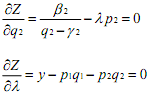
and set its first partial derivatives equal to zero (we assume interior solution of this maximisation problem):  
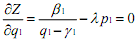
954_RECENT DEVELOPMENT IN DEMAND ANALYSIS4.png

1724_RECENT DEVELOPMENT IN DEMAND ANALYSIS5.png

It can be easily verified that the second order condition for the maximisation is satisfied. By evaluating the above three equation one can also find out that the marginal utility of income is decreasing. 

Solving the above equations for optimal quantities gives the demand functions,  
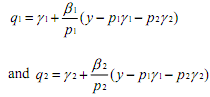
563_RECENT DEVELOPMENT IN DEMAND ANALYSIS6.png

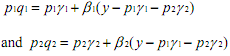
Multiplying the first equation of the above two demand functions by p1 and the second by p2 we get the expenditure functions  
1646_RECENT DEVELOPMENT IN DEMAND ANALYSIS7.png

which are linear in income and prices, and thus suitable for linear regression analysis.  


Related Discussions:- Recent development in demand analysis

Fixed input and variable input, Fixed input and variable input: A fixe...

Fixed input and variable input: A fixed input is that input whose quantity cannot be varied in the short-run when demand conditions require an increase or a decrease in produc

Market structure, discuss the implications of various market structure for ...

discuss the implications of various market structure for price determination

Need Econ Help, Two firms produce a pollutant called Q. The total costs of...

Two firms produce a pollutant called Q. The total costs of reducing emissions of Q are as follows for Firm 1 and Firm 2, respectively: TC1=10+100Q12 TC2=20 + 50Q22. This means tha

Calculate the price of a forward contract, Commodities A) It i...

Commodities A) It is well documented that commodity prices are very volatile when compared to other asset classes.  Discuss factors that cause volatility in the commod

Monopoly, if the inverse demand curve is p=120-Qand the marginal cost is co...

if the inverse demand curve is p=120-Qand the marginal cost is constant at 10, how does charging the monopoly a specific tax of 10 per unit affect the monopoly optimum and the welf

1, Find the market-clearing price and quantity of burritos.

Find the market-clearing price and quantity of burritos.

Determinants of demand for education, Normal 0 false false ...

Normal 0 false false false EN-IN X-NONE X-NONE MicrosoftInternetExplorer4

Write Your Message!

Captcha
Free Assignment Quote

Assured A++ Grade

Get guaranteed satisfaction & time on delivery in every assignment order you paid with us! We ensure premium quality solution document along with free turntin report!

All rights reserved! Copyrights ©2019-2020 ExpertsMind IT Educational Pvt Ltd