Probability distribution for continuous random variables, Mathematics

Assignment Help:

Probability Distribution for Continuous Random Variables

In a continuous distribution, the variable can take any value within a specified range, e.g. 2.21 or 1.64 compared to the specific values taken by a discrete variable e.g 1 or 3. The probability is represented by the area under the probability density curve between the given values.

The uniform distribution, the normal probability distribution and the exponential distribution are examples of a continuous distribution

-           The normal distribution is a probability distribution which is used to determine probabilities of continuous variables

Examples of continuous variables are

  • Times
  • Capacity Heights
  • Weights
  • Distances
  • e.t.c

- Generally continuous variables are those that can be measured by utilizing the suitable units of measurement.

- specified are the properties of the general distribution

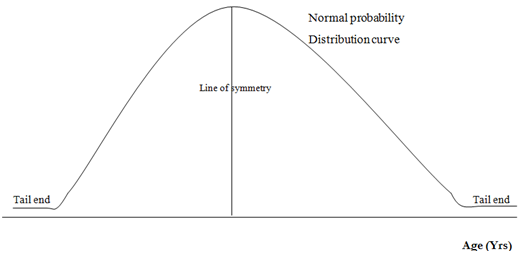
1. The sum of area under the curve is = 1 which is equivalent to the maximum value of probability
701_Probability Distribution for Continuous Random Variables.png

2. The line of symmetry divides curve into two equal halves

3. The two ends of the general distribution curve continuously approach the horizontal axis however they never cross it

4. The values of the mean, mode and median all each are equal

NB: The above distribution curve is referred to as general probability distribution curve since if a frequency distribution curve is plotted from measurements of a specified sample drawn from a general population then a graph similar to the normal curve must be acquired.

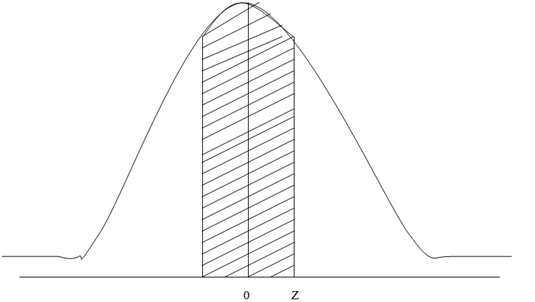
- It should be noted that 68 percent of any population lies in one standard deviation, ±1σ

- 95 percent lies in two standard deviations ±2σ

- 99 percent lies in three standard deviations ±3σ

Whereas σ = standard deviation
182_Probability Distribution for Continuous Random Variables 2.png


Related Discussions:- Probability distribution for continuous random variables

Approximating solutions to equations newtons method, Approximating solution...

Approximating solutions to equations : In this section we will look at a method for approximating solutions to equations. We all know that equations have to be solved on occasion

Linear programming , use the simplex method to solve the following lp probl...

use the simplex method to solve the following lp problem. max z = 107x1 + x2 + 2x3 subject to 14x1 + x2 - 6x3 + 3x4 = 7 16x1 + x2 - 6x3 3x1 - x2 - x3 x1,x2,x3,x4 > = 0

Sketch the graph f ( x ) = - x5 + (5/2 )x4 + (40/3) x3 + 5, Sketch the grap...

Sketch the graph of the below function. f ( x ) = - x 5 + (5/2 )x 4 + (40/3) x 3 + 5 Solution : Whenever we sketch a graph it's good to have a few points on the graph to

Area of an ellipse, You know the experation for the area of a circle of rad...

You know the experation for the area of a circle of radius R. It is Pi*R 2 . But what about the formula for the area of an ellipse of semi-minor axis of length A and semi-major

Calculus!, x+2y^2=63 and 4x+y^2=0; Find the area of the regions enclosed by...

x+2y^2=63 and 4x+y^2=0; Find the area of the regions enclosed by the lines and curves.

Clique graph, Consider the clique graph below. a) How many subgraph...

Consider the clique graph below. a) How many subgraphs of G with 3 nodes are there?  b) How many of the subgraphs defined in part(a) are induced subgraphs?

Linear relations, a drawn picture on a graph that includes equations of eac...

a drawn picture on a graph that includes equations of each line

Elimination, Eliment t from following equations v=u+at s=ut+1/2at^2

Eliment t from following equations v=u+at s=ut+1/2at^2

Write Your Message!

Captcha
Free Assignment Quote

Assured A++ Grade

Get guaranteed satisfaction & time on delivery in every assignment order you paid with us! We ensure premium quality solution document along with free turntin report!

All rights reserved! Copyrights ©2019-2020 ExpertsMind IT Educational Pvt Ltd