How to find the range of a function, Mathematics

Assignment Help:

How to Find the range of a function ?

Sigh. Students ask me this all the time. They don't want an explanation, they want a procedure. "Tell me the steps!"

Unfortunately, there is no step-by-step procedure. The only way to answer this question is first to have an understanding of what range means, and then to examine the function and try to understand it. This usually means graphing the function. By the way, if you're not sure what "range" means, then click on the basics button.

Now, usually the only way to find the range of a function is to graph it (or at least, visualize the graph in your head). In the graph, the range is the set of y values (not x values) through which the graph passes.
Example 1
1896_eq..png

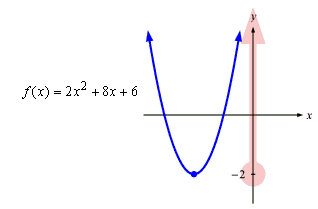
For example, this function's graph is a parabola:
467_eq. 1.png

The range is shown in red on the y-axis: it consists of all real numbers greater than or equal to -2. You can see that the range matches the vertical extent of the graph: y = -2 is the lowermost point of the parabola.

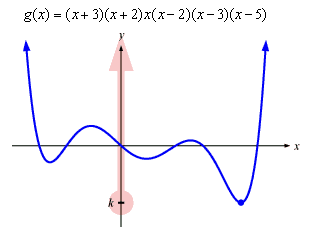
But you wouldn't know this unless you knew how to find the vertex of the parabola. This is what I mean by "having an understanding of the function." Each function is different, and it usually requires some thought to figure out what the range is. Sometimes, it is very difficult. Take a look at this next example:


Related Discussions:- How to find the range of a function

Non zero sum games- game theory, Non Zero Sum Games Recently there was ...

Non Zero Sum Games Recently there was no satisfactory theory either to describe how people should play non-zero games or to explain how they actually play that game Nigel Ho

Logarithms, We know that 2 4 = 16 and also that 2 is referred to as ...

We know that 2 4 = 16 and also that 2 is referred to as the base, 4 as the index or power or the exponent. The same if expressed in terms of logarithms would be log 2

The Theory of Set, Set M= {m''s/m is a number from 5 to 10}

Set M= {m''s/m is a number from 5 to 10}

Solution to an initial value problem, S olve the subsequent IVP. dv/dt =...

S olve the subsequent IVP. dv/dt = 9.8 - 0.196v;               v(0) = 48 Solution To determine the solution to an Initial Value Problem we should first determine the gen

Factoring, how are polynomials be factored/?

how are polynomials be factored/?

Compound interest, Draw a flowchart for accumulated principal at the end of...

Draw a flowchart for accumulated principal at the end of 5 years by taking into account compound interest?

Index of summation - sequences and series, Index of summation - Sequences a...

Index of summation - Sequences and Series Here now, in the i is termed as the index of summation or just index for short and note that the letter we employ to represent

Center of mass - applications of integrals, Center of Mass - Applications o...

Center of Mass - Applications of integrals In this part we are going to find out the center of mass or centroid of a thin plate along with uniform density ρ. The center of mass

Solve for, a)Solve for ?, if tan5? = 1. Ans:    Tan 5? = 1        ⇒ ? ...

a)Solve for ?, if tan5? = 1. Ans:    Tan 5? = 1        ⇒ ? =45/5 ⇒ ?=9 o . b)Solve for ? if S i n ?/1 + C os ? + 1 +  C os ?/ S i n ? = 4 . Ans:  S i n ?/1 +

Eulers Method, Euler's Method Up to this point practically all differe...

Euler's Method Up to this point practically all differential equations which we've been presented along with could be solved. The problem along with this is which the exceptio

Write Your Message!

Captcha
Free Assignment Quote

Assured A++ Grade

Get guaranteed satisfaction & time on delivery in every assignment order you paid with us! We ensure premium quality solution document along with free turntin report!

All rights reserved! Copyrights ©2019-2020 ExpertsMind IT Educational Pvt Ltd