Graphical representation of various returns, Microeconomics

Assignment Help:

Graphical Representation of Various Returns:

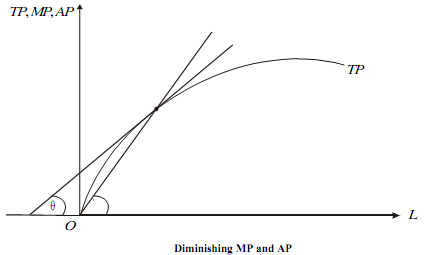
Diminishing Returns: If the TP curve is as shown in the adjacent Figure, then the MPL given by tanθ  is throughout less than the APL given by tanθ.  


1133_Graphical Representation of Various Returns.png

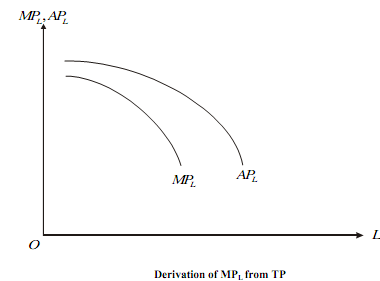
As APL is falling from the relation between MP and AP, MP < AP we have the adjoining Figure.   
195_Graphical Representation of Various Returns1.png

Increasing Returns Here APL rises and tan  < tanθ , for all L. Therefore, MP > AP. This is shown in the adjacent Figure.  
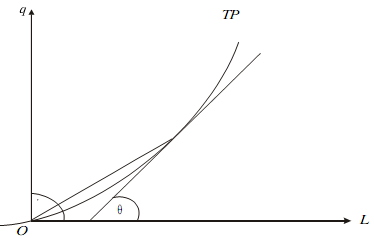
 

677_Graphical Representation of Various Returns2.png


Constant Returns Here, APL is constant and tanθ  = tan , therefore, MPL = APL as is shown by a horizontal straight line in the next Figure(a,b)   
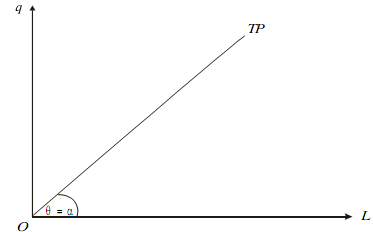
2493_Graphical Representation of Various Returns3.png

The TP curve is such that upto point A, MP is rising and so is AP and MP > AP, as shown in the diagram below. Beyond point A, MP falls but AP rises, till the two are equated at point B. At B, AP is maximised. AP falls beyond the point B. At point C, the TP curve flattens out and therefore, MP = 0. Beyond C, MP is negative and AP is falling. Therefore, in the case of non-proportional return, both MP and AP rise, initially. MP reaches a maximum earlier than AP. When they both are equated, AP is maximised. Finally, there is a situation where both are falling. Depending on the nature of MP and AP, the production process can be divided into three stages - I, II, and III, as shown in Figure. 

Characteristics of the three stages are : 

Stage I: MP > 0, AP rising, thus MP > AP 

Stage II: MP > 0, AP falling, thus MP < AP 

Stage III: MP < 0, AP falling  

In stage I, by adding one more unit of L, the producer can increase the average productivity of all the units. Thus, it would be unwise for the producer to stop production in this stage. 

In stage III, MP < 0, so that by reducing the L input, the producer can increase the total output and save the cost of a unit of L. Therefore, it is impractical for a producer to produce in this stage. 

Hence, stage II represents the economically meaningful range. This is so because here MP > 0 and AP > MP. So that an additional L input would raise the total production. Besides, it is in this stage that the TP reaches a maximum.  


Related Discussions:- Graphical representation of various returns

Theory of oligopolistic competition, Theory of Oligopoly: Oligopoly is that...

Theory of Oligopoly: Oligopoly is that situation where the number of firms in the market is large but not as large as in the case of perfect competition so that it is possible for

Demand for the big mac on the rise, illustrate and explain the changing dem...

illustrate and explain the changing demand for big mac using the indifference curve and budget line

MR, prove that the utility approach and the indifference curve approach yie...

prove that the utility approach and the indifference curve approach yield the same consumer equilibrium

What is mixed economy, Mixed Economy: This type of economic system combines...

Mixed Economy: This type of economic system combines the features of both the capitalist and socialist economic systems. The private sector is allowed to function on the principles

Supply analysis, what is the explanation about supply analysis?How to under...

what is the explanation about supply analysis?How to understand?

Explain fixed capital and flat-rate tax, Q. Explain Fixed Capital and Flat-...

Q. Explain Fixed Capital and Flat-Rate Tax? Fixed Capital: Realcapital which is installed permanently in a specific location, including infrastructure, buildings and major eq

Financial market, Explain the effect of increased money supply on bond pric...

Explain the effect of increased money supply on bond prices

The cost of production, crumble corporation produce biscuits. here the rela...

crumble corporation produce biscuits. here the relation between the number of workers and output

Calculate the mc function and fixed cost, (i). A firm's costs are 500 when ...

(i). A firm's costs are 500 when output is 100. If the TC function is linear and fixed cost (FC) are 200, find the marginal cost when Q = 4, 5 and 6. (ii). The following are est

Write Your Message!

Captcha
Free Assignment Quote

Assured A++ Grade

Get guaranteed satisfaction & time on delivery in every assignment order you paid with us! We ensure premium quality solution document along with free turntin report!

All rights reserved! Copyrights ©2019-2020 ExpertsMind IT Educational Pvt Ltd