Expression trees, Data Structure & Algorithms

Assignment Help:

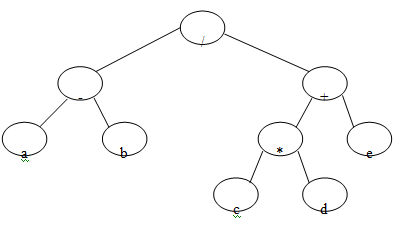
What are the expression trees? Represent the below written expression using a tree.

Give a relevant comment on the result that you get when this tree is traversed in Preorder, Inorder and postorder. (a-b) / ((c*d)+e)

The leaves of an expression tree are operands, for instance constants or variable names, and the other nodes include operators. This particular tree happens to be a binary tree, because all of the operations are binary, and although this is the easiest case, it is probable for nodes to have more than two children. It can also be possible for a node to have only one child, as is the case with the unary minus operator. We can evaluate the expression tree, T, by applying the operator at the root of it  to the values obtained by recursively evaluating the left and right subtrees.

The expression tree obtained for the expression: (a - b ) / ( ( c * d ) + e))
1269_expression_tree.png

The traversal of the above drawn expression tree gives the following result:-

Preorder:- ( / - a b + * c d e)

This expression is the same as the "prefix notation" of the original expression.

Inorder:- ( a - b) / ((c * d) + e )

Thus the inorder traversal gives us the actual expression.

Postorder:- ( a b - c d * e + / )

Thus the postorder traversal of this gives us the "posfix notation" or we can say the "Reverse Polish notation" of the original expression.


Related Discussions:- Expression trees

Pest control program, PART- Pest Control Program Prepare a Pest Contro...

PART- Pest Control Program Prepare a Pest Control Program for the facility that will address the management of Rodents, Insects and Birds. Your Pest Control Program should

Logical database design, 1. For the ER diagram you created in assignment, t...

1. For the ER diagram you created in assignment, the artefact of the conceptual database design, map the ER model into the relational model according to how it was designed in the

Stack, Explain in detail the algorithmic implementation of multiple stacks....

Explain in detail the algorithmic implementation of multiple stacks.

Define binary tree, Define Binary Tree  A binary tree T is explained as...

Define Binary Tree  A binary tree T is explained as a finite set of nodes that is either empty or having of root and two disjoint binary trees TL, and TR known as, respectively

Program insertion of a node into any circular linked list, Program Insertio...

Program Insertion of a node into any Circular Linked List Figure depicts a Circular linked list from which an element was deleted. ALGORITHM (Deletion of an element from a

Binary search tree (bst), Q. Explain what do we understand by Binary Search...

Q. Explain what do we understand by Binary Search Tree (BST)? Make a BST for the following given sequence of the numbers. 45, 32, 90, 21, 78, 65, 87, 132, 90, 96, 41, 74, 92

Deletion algorithm for dequeue, Deletion Algorithm for dequeue Step 1:...

Deletion Algorithm for dequeue Step 1: [check for underflow]   If front = 0 and rear = 0   Output "underflow" and return Step 2: [delete element at front end]   If front

Travelling salesman problem, Example 3: Travelling Salesman problem G...

Example 3: Travelling Salesman problem Given: n associated cities and distances among them Find: tour of minimum length that visits all of city. Solutions: How several

Hash function, Q. Define the graph, adjacency matrix, adjacency list, hash ...

Q. Define the graph, adjacency matrix, adjacency list, hash function, adjacency matrix, sparse matrix, reachability matrix.

Write Your Message!

Captcha
Free Assignment Quote

Assured A++ Grade

Get guaranteed satisfaction & time on delivery in every assignment order you paid with us! We ensure premium quality solution document along with free turntin report!

All rights reserved! Copyrights ©2019-2020 ExpertsMind IT Educational Pvt Ltd