Example on passing parameters through stack, Computer Engineering

Assignment Help:

Q. Example on Passing Parameters through Stack?

PROGRAM: Version 3

DATA_SEG               SEGMENT

                        BCD DB 25h; Storage for BCD test value

BIN DB?  ; Storage for binary value

DATA_SEG               ENDS

STACK_SEG   SEGMENT      STACK

DW 100 DUP (0); Stack of 100 words

TOP_STACK   LABEL    WORD

STACK_SEG   ENDS

CODE_SEG SEGMENT

ASSUME CS: CODE_SEG, DS: DATA_SEG, SS: STACK_SEG

START:           MOV AX, DATA                  ; Initialise data segment


MOV DS, AX                                    ; using AX register

MOV AX, STACK-SEG.      ; initialise stack segment

MOV SS, AX                         ; using AX register

MOV SP, OFFSET TOP_STACK; initialise stack pointer

MOV AL, BCD                      ; Move BCD value into AL

PUSH AX                               ; and push it onto word stack

CALL BCD_BINARY          ; Do the conversion

POP AX                                  ; Get the binary value

MOV BIN, AL                       ; and save it

NOP                                        ; Continue with program


; PROCEDURE: BCD_BINARY Converts BCD numbers to binary.

; INPUT   : None - BCD value assumed to be on stack before call

; OUTPUT   : None - Binary value on top of stack after return 

; DESTROYS: Nothing

BCD_BINARY PROC NEAR

                                 PUSHF     ; Save flags

                                 PUSH AX; and registers: AX

                                 PUSH BX; BX

                                 PUSH CX; CX

                                 PUSH BP; BP. Why BP?

                                 MOV BP, SP; Make a copy of the

                                                ; stack pointer in BP

                                 MOV   AX, [BP+ 12]; Get BCD number from

                                                ; stack. But why it is on 


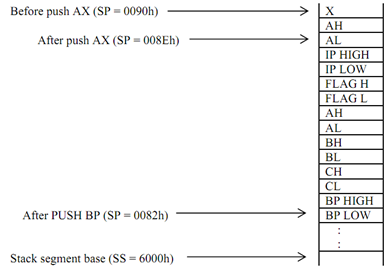
; BP+12 location? Please note 5 PUSH statements + 1 call which is intra-segment (so 

; just IP is stored) so total 6 words are pushed after AX has been pushed and since it is 

; a word stack so the BCD value is stored on 6 × 2 = 12 locations under stack. Hence 

; [BP + 12] (refer to the figure given on next page).

MOV BL, AL; Save copy of BCD in BL

AND BL, 0Fh; mask lower 4 bits

AND AL, F0H; Separate upper 4 bits

MOV CL, 04; Move upper BCD digit to low

ROR   AL, CL; position BCD digit for multiply location

MOV   BH, 0Ah   ; Load 10 in BH

MUL BH; Multiply upper BCD digit in AL by 10

   ; The result is in AL

ADD   AL, BL; Add lower BCD digit to result.

MOV [BP + 12], AX   ; Put binary result on stack

; Restore flags and registers

POP BP

POP CX

POP BX

            POP AX

                                 POPF  

                                 RET  

BCD_BINARY       ENDP

CODE_SEG            ENDS

END   START  


Discussion: 

The parameter is pushed on stack before the procedure call. Procedure call causes the current instruction pointer to be pushed on to stack. In the procedure flags AX, BX, CX and BP registers are also pushed in that order. Hence the stack looks to be:
721_Example on Passing Parameters through Stack.png

The instruction MOV BP, SP transfers contents of the SP to BP register. Now BP is used to access any location in stack by adding appropriate offset to it. For illustration MOV AX, [BP + 12] instruction transfers the word starting at the 12th byte from the top of stack to AX register. It doesn't change the contents of BP register or top of the stack. It copies pushed value of AL and AH at offset 008Eh into the AX register. This instruction isn't equivalent to POP instruction. 

Stacks are useful for writing procedures for multi-user system programs or recursive procedures. It's a decent practice to make a stack diagram as above when using procedure call through stacks. This helps in reducing errors in programming.


Related Discussions:- Example on passing parameters through stack

Explain about the acoustic tablet, Explain about the Acoustic tablet Ac...

Explain about the Acoustic tablet Acoustic (or sonic) tablet use sound waves to detect a stylus position. Either strip microphones or point microphones can be used to detect th

General principles of pruning, General principles of pruning: The gene...

General principles of pruning: The general principles are such that: 1. Given a node N that can be chosen by player one, thus if there is another node, X, along any path,

Determine the odd parity bit for f, Q. Determine the odd parity bit for F. ...

Q. Determine the odd parity bit for F. Q. Convert the following from binary to decimal, hexadecimal, BCD and octal. a) 1000000011   b) 0001010110101  c) 1 Q. Convert the f

What is optical mark recognition, Optical mark recognition (OMR)  OMR ...

Optical mark recognition (OMR)  OMR technology scans a printed form and reads pre-defined positions (where specific fields have been filled in for instance ?-?or _); system re

Visibility, hidden edge/surface removal

hidden edge/surface removal

Explain the advantages of high level languages, Explain the Advantages of H...

Explain the Advantages of High Level Languages? The major advantage of high-level languages over low-level languages is that they are easier to write, read, and maintain. Ultim

Push and pop, Suupose a stack-oriented processor that haves the stack opera...

Suupose a stack-oriented processor that haves the stack operations PUSH and POP.  Arithmetic operations automatically involve the top one or two stack elements. Starting with an

Name the modes of 8255 programmable peripheral interface, What are the diff...

What are the different modes in that 8255 Programmable Peripheral Interface (PPI) can operate?  24 I/O lines in 3-8-bit port groups - A, B, C A, B can be 8-bit input

What is laser printers, Q. What is Laser Printers? Laser Printers are p...

Q. What is Laser Printers? Laser Printers are page printers. For print quality they also face same addressability issues as DMP/InkJet Printers. Though some other methods are p

Find the number of PROM chips & address lines, The capacity of 2K × 16 PROM...

The capacity of 2K × 16 PROM is to be expanded to 16 K × 16.  Find the number of PROM chips required and the number of address lines in the expanded memory. Ans. Capacity requi

Write Your Message!

Captcha
Free Assignment Quote

Assured A++ Grade

Get guaranteed satisfaction & time on delivery in every assignment order you paid with us! We ensure premium quality solution document along with free turntin report!

All rights reserved! Copyrights ©2019-2020 ExpertsMind IT Educational Pvt Ltd