Define wilkes control unit, Computer Engineering

Assignment Help:

Q. Define Wilkes Control Unit?

Prof. M. V. Wilkes of the Cambridge University Mathematical Laboratory invented the term microprogramming in 1951. He offered a systematic alternative process for designing control unit of a digital computer. At the time of instruction executing a machine instruction, a sequence of transformations and transfer of information from one register in processor to another take place. These were also known as the micro operations. Due to the analogy between the executions of individual steps in a machine instruction to execution of individual instruction in a program. Wilkes introduced the idea of microprogramming. Wilkes control unitreplaces the combinational and sequential circuits of hardwired CU by a simple CU in conjunction with a storage unit which stores the sequence of steps of instruction which is a micro-program.

In Wilkes microinstruction has two main components:

a)  Control field thatdenotes the control lines which are to be activated and

b)  Address field that provides address of the subsequent microinstruction to be executed.

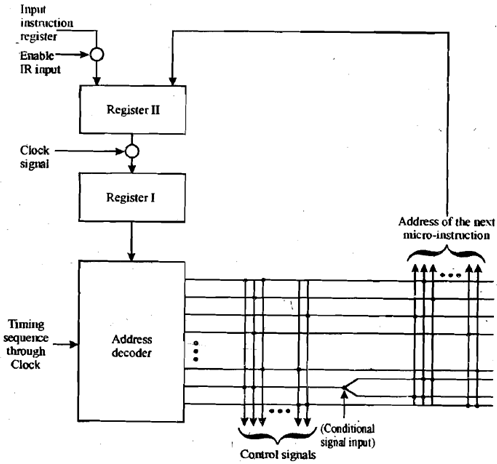
The figure below is an illustration of Wilkes control unit design. 
1315_Define Wilkes Control Unit.png

Figure: Wilkes Control Unit

The control memory in Wilkes control is organized like a PLA's like matrix made of diodes. This is partial matrix and comprises two components the control signals and address of the subsequent micro-instruction. Register I comprises the address of next micro-instruction which is one step of instruction execution, for illustration T1 in M1 or T2 in M2 etc. as in Figure below. On decoding the control signals are producedwhich cause execution of micro-operation(s) of that step. Additionally the control unit denotes the address of next micro-operation that gets loaded through register II to register I. Register I can also be loaded by register II and enable IR input control signal. This will pass address of first micro-instruction of execute cycle. At the time of a machine cycle one row of the matrix is triggered. The first portion of the row produces the control signals which control the operations of the processor. Second part produces the address of row to be selected in next machine cycle. 

At beginning of the cycle the address of the row to be selected is contained in register I. This address is input to decoder that is activated by a clock pulse.

This triggers the row of control matrix. Two-register arrangement is required as the decoder is a combinational circuit; with only one register output would become input at the time of a cycle. This can be an unstable condition because of repetitive loop.


Related Discussions:- Define wilkes control unit

What is the pcm pulse or symbol transmission rate, An analog information si...

An analog information signal, whose maximum frequency is 6000Hz, is to be transmitted using a PCM system. The quantization error must not exceed the ±1 % of the peak-topeak analog

Can you list out some of enhancements in verilog 2001, Can you list out som...

Can you list out some of enhancements in Verilog 2001? In  earlier  version  of  Verilog,  we  use  'or'  to  specify  more  than  one  element  in  sensitivity  list.  In Veri

Structural hazards - computer architecture, Structural hazards - computer a...

Structural hazards - computer architecture: A structural hazard takes place when a part of the processor's hardware is required by 2 or more than two instructions at the same

Writing down your own interrupt service routines, Q. Writing down your own ...

Q. Writing down your own Interrupt Service Routines? Here are a few rules which should be kept in mind while writing down your own Interrupt Service Routines: 1.  Use Int 21

What are subroutines, What are subroutines? Subroutines are program mo...

What are subroutines? Subroutines are program modules, which can be known  from other ABAP/4 programs or within the similar program.

What will be the output of JK flipflop for J = 0 and K=1, For JK flipflop J...

For JK flipflop J = 0, K=1, the output after clock pulse will be ? Ans. J=0 and K=1, such inputs will reset the flip-flop, after the clock pulse. Therefore whatever be the earlie

Describe the horizontal frequency or cycle, Q. Describe the Horizontal Freq...

Q. Describe the Horizontal Frequency or cycle? Horizontal Frequency: The time to scan one line connecting the right edge to left edge of the screen horizontally is known as t

Tightly coupled system- shared memory system, Tightly Coupled System- Share...

Tightly Coupled System- Shared Memory System Shared memory multiprocessorshas has following description: Every processor commune through a shared global memory. For

What are the features of the hardwired control, What are the features of th...

What are the features of the hardwired control? A controller that uses this approach can function at high speed. It has little flexibility and the complexity of the instruction

What is the relationship between clipping and repainting, When a window is ...

When a window is repainted by the AWT painting thread, it sets the clipping regions to the area of the window that needs repainting.

Write Your Message!

Captcha
Free Assignment Quote

Assured A++ Grade

Get guaranteed satisfaction & time on delivery in every assignment order you paid with us! We ensure premium quality solution document along with free turntin report!

All rights reserved! Copyrights ©2019-2020 ExpertsMind IT Educational Pvt Ltd