Define the type casting?, JAVA Programming

Assignment Help:


Type casting defines treating a variable of one type as though it is another type.

When up casting primitives as given below from left to right, automatic conversion happens. But if you derive from right to left, explicit casting or down casting is needed. Casting in Java is safer and easier than in C or other languages that allow arbitrary casting. Java only lets casts happen when they build sense, such as a cast between a float and an int. However you can't cast between a String and an int.

Byte, short, int, long, float, and double

int i = 5;

long j = i;         //Right. Implicit casting or up casting

byte b1 = i;      //Wrong casting. Compile time error "Type Mismatch".

byte b2 = (byte) i ;       //Right. Explicit casting or Down casting is required.

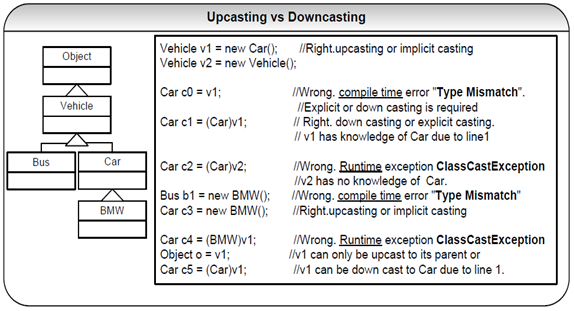
When it needs to object references you may always cast from a subclass to a superclass because a subclass object is also a superclass instance. You may cast an object implicitly to a super class type. If that were not the case polymorphism couldn't be possible.


2281_Untitled.png


You can cast down the hierarchy as well but you have to explicitly write the cast and the object must be a legitimate instance of the class you are casting to. The ClassCastException is given to indicate that code has tried to cast an object to a subclass of which it is not an instance of that class. If you are using J2SE 5.0 then "generics" will remove the need for casting otherwise you may deal with the problem of incorrect casting in two ways:

1.      Use the exception handling process to catch ClassCastException.

2.      Use the instance of statement to protect against incorrect casting.


Related Discussions:- Define the type casting?

Error, UnsupportedClassVersionError

UnsupportedClassVersionError

What is a java package and how is it used, A Java package is a naming conte...

A Java package is a naming context for classes and interfaces. A package is used to make a separate name space for groups of classes and interfaces. Packages are also used to arran

Differentiate between primitives and objects, Differentiate between Primiti...

Differentiate between Primitives and Objects Everything in Java is an "Object", as every class by default inherits from class "Object", except a few primitive data t

Method to define the packages in java programme, Q. Write the method to def...

Q. Write the method to define the packages in java programme. Explain. Ans. Package: When we work on a project we have to break our programme in several classes. To organize

Need to develop web server, Project Description: I wish to prepare a Web...

Project Description: I wish to prepare a Web server which provides subsequent Web Services. 1. User login 2. User input data store to server 3. User fetches results fro

Program using a data structure to represent a set, * Using a data structure...

* Using a data structure to represent a set * Writing and using a checked exception * Extending the Exception class What should you upload via Blackboard? The files,

Complete the implementation of the class, The class TurtleQTwo extends Turt...

The class TurtleQTwo extends Turtle by adding one new method, plus, which is specified below. (All other features of TurtleQTwo are the same as for Turtle.) method plus(n in

Java, 1. Which of the following are not valid Java identifiers, and why? (...

1. Which of the following are not valid Java identifiers, and why? (a) wolVes (b) United(there is only one) (c) 87 (d) 5 3 (e) Real ale (f) isFound?by 2. A class Television

Explain init(), Explain init(), start(), stop(), and destroy() method? ...

Explain init(), start(), stop(), and destroy() method? The init() method is known as exactly once in an applet's life, while the applet is first loaded. It's generally used to

Write Your Message!

Captcha
Free Assignment Quote

Assured A++ Grade

Get guaranteed satisfaction & time on delivery in every assignment order you paid with us! We ensure premium quality solution document along with free turntin report!

All rights reserved! Copyrights ©2019-2020 ExpertsMind IT Educational Pvt Ltd